As production loads change, energy demand changes with them. If these changes can only be addressed after they occur, energy may be produced at the wrong time or in the wrong amount, available capacity may be underutilised, and process fluctuations may affect production stability and product quality. Ultimately, all of this also has a financial impact.
Many industrial plants already have large amounts of data about their operations. Data is continuously collected from automation systems, equipment and energy consumption, but it often tells us primarily what is happening now and what has already happened. Optimisation takes this one step further: what will happen in the process next, and can the necessary adjustments be made in time?
In practice, industrial energy optimisation means managing energy production and consumption according to actual and forecast production demand. The aim is to reduce energy waste, improve energy efficiency, make better use of available capacity and maintain a stable process. Historical data and forecasts are combined with real-time information so that changes in production can be anticipated earlier.
Production optimisation starts with the process and available data
When developing an optimisation solution, we start by reviewing the existing process, available data and the desired outcome together with the customer. In one case, the goal may be to reduce energy waste, while in another it may be to improve utilisation or make more effective use of existing capacity. At the same time, we define the metrics that will later be used to evaluate the results.
Laura Leskinen, Business Director at PlantSys, highlights data validation as an important part of this work. The available data is assessed against what the customer wants to achieve through optimisation. This also helps identify gaps or limitations in the data and determine how they can be addressed together with the customer. The customer’s own knowledge of the process is particularly valuable at this stage.
“AI is a valuable tool for optimisation and forecasting, but the first step is to review the existing data,” Leskinen explains.
The first stages of process optimisation can often be built using physical and mathematical models. There may not initially be enough high-quality data for machine learning, but this does not prevent optimisation from getting started. As more is learned about the process and more data becomes available, machine learning can be used to refine the models and take the optimisation further.
PlantSys also uses hybrid modelling, combining physical process models with AI and machine learning models in selected applications. Machine learning can be used for forecasting, anomaly detection and generating recommendations. Models can also incorporate external information, such as weather forecasts, as well as data from production management systems.
From predictive analytics to practical optimisation
Having visibility a few hours into the future can be considerably more valuable for production than knowing only the current level of energy consumption. If energy demand is expected to increase, preparations can be made before the consumption peak occurs. Similarly, a forecast decrease in demand can be taken into account in energy production in advance.
PlantSys Optimisation provides process users with forecasts and recommendations that can be used to adjust process operation. Users are deliberately closely involved during the initial stages. According to Leskinen, optimisation is developed together with the people who know the process and work with it every day. This also makes it possible to evaluate how the recommendations perform under real production conditions.
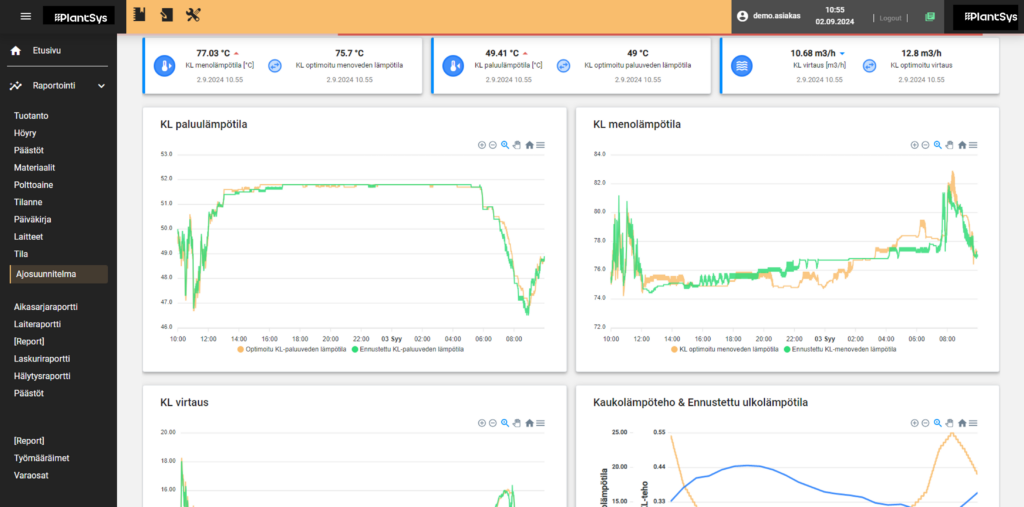
Predictive analytics shows how the situation is likely to develop. Optimisation uses this information to determine how the process should be operated to achieve the defined objective. Once sufficient experience has been gained from the model and its results, the optimisation can be taken further and adjustments can be integrated directly into the customer’s process control.
Production use also requires a robust architecture, cybersecurity and continuous maintenance. PlantSys takes these requirements into account when developing optimisation solutions so that they continue to support the customer’s process and its users over the long term.
How can the business value of optimisation be measured?
The success of optimisation should be measured against the objectives it was designed to achieve. According to Leskinen, the relevant metrics should therefore be agreed before the optimisation work begins. If the objective is to reduce energy waste, one clear metric is the amount of wasted energy before and after optimisation. In another application, the relevant measures might include utilisation, capacity utilisation or process stability.
This also shows how a technical improvement translates into financial value. Reduced energy waste and optimised fuel use affect energy costs. On the production side, value may come from using existing capacity more effectively or maintaining more stable process operation. The metrics are selected according to the customer’s process and objectives, making it possible to track the financial impact of optimisation as well.
Most companies already have at least some of the data required for optimisation. The first step is to identify where the greatest optimisation potential lies in production or energy use and determine which metrics should be used to measure its impact. From there, the optimisation can be developed step by step based on the results and the data that continues to accumulate.
Optimising the energy balance of an industrial plant
The relationship between production and energy use becomes particularly important in processes where energy demand changes rapidly. When future demand can be forecast, energy production can be better aligned with production needs and adjustments can be made in advance.
We have prepared a case study showing how PlantSys is used to forecast and optimise the energy balance of an industrial plant. The case study covers the initial situation, the data used, how the optimisation works and the business benefits it is designed to achieve.
Let’s discuss production and energy optimisation at Alihankinta Subcontracting Fair Finland
If your production energy demand varies, you need better visibility into upcoming process changes, or you want to make more effective use of your existing capacity, come and meet Laura Leskinen and the rest of the PlantSys team in Hall A, Stand A1218.
We can start with your production process: what data is already available, where the greatest optimisation potential may lie, and what kind of business value could be achieved by making better use of it.